
Polished Concrete
Progressive diamond grinding, densification, and honing that turn the slab itself into the finished floor — matte to mirror gloss, with nothing to peel or re-coat.
Request a Free EstimateWhat is polished concrete?
Polished concrete is a mechanical process, not a coating. Progressively finer diamond tooling grinds and hones the slab, a penetrating silicate densifier hardens the surface, and resin-bond pads refine it to the sheen you specify — matte, satin, semi-gloss, or high gloss. Because the finish is the concrete, there is nothing to peel, flake, or delaminate, and integral dyes can add color, borders, or logos during polishing. A penetrating stain guard protects against spills and tire marking. Slabs that need patching or flattening first are handled in-house — see concrete repairs and underlayments.
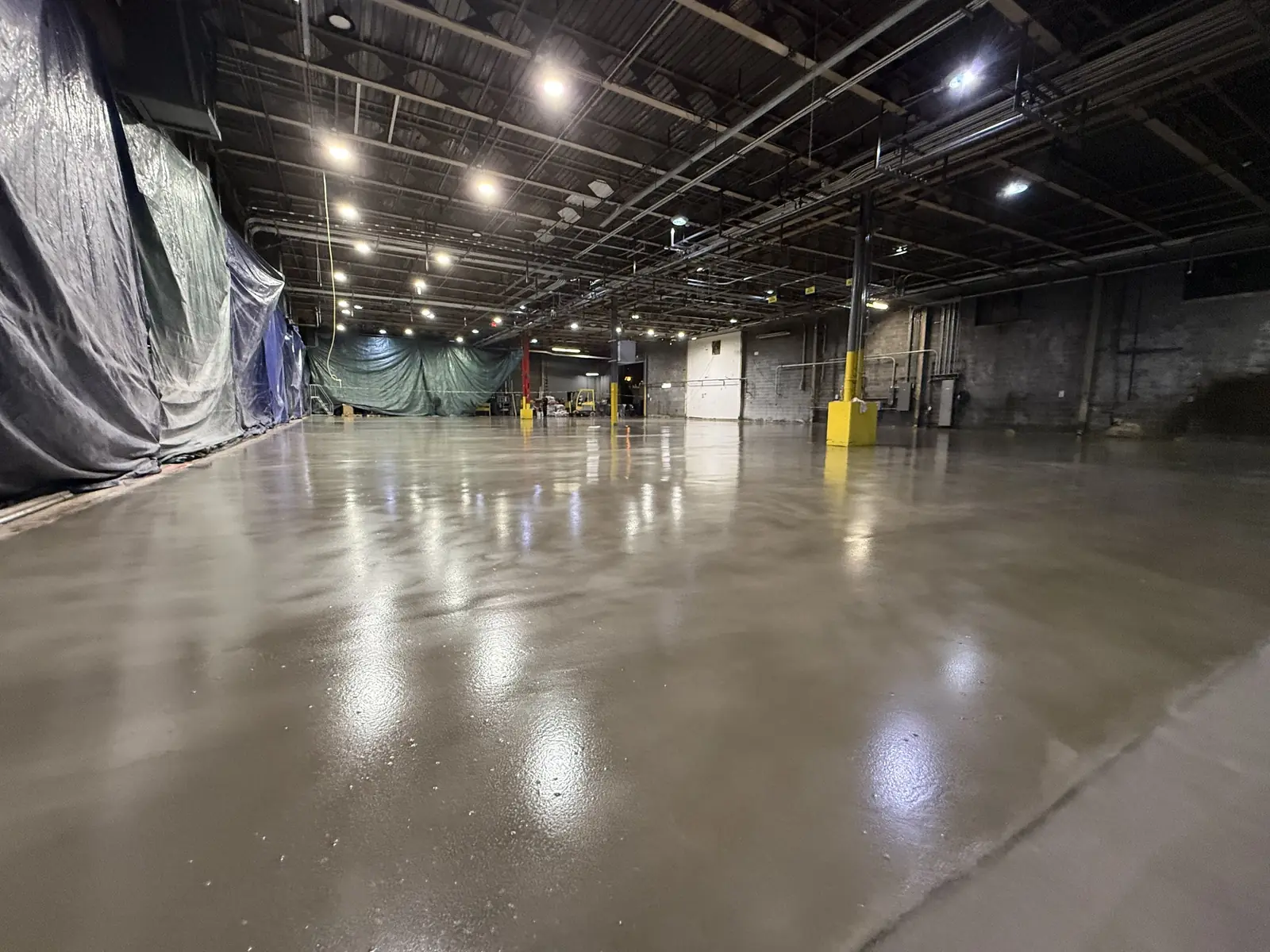
No coating. Nothing to fail.
- Mechanically refined — can’t peel, flake, or delaminate
- Densified & hardened for decades of traffic
- Sheen specified by grit — matte to high gloss
- Stain guard resists spills & tire marking
- Lowest life-cycle cost — no waxing, no re-coating
- High light reflectivity cuts lighting loads
From showrooms to warehouses.
Ground. Densified. Polished.
Hardness, flatness, moisture, and prior coatings evaluated to plan the grit sequence and any repairs.
Metal-bond diamonds cut the slab flat and expose the specified aggregate level.
Penetrating densifier reacts within the slab, hardening it against wear and dusting.
Resin-bond pads step from 100 to 1500+ grit to build the exact sheen.
Stain guard applied and burnished for showroom-level reflectivity.
Hiring a Polished Concrete Contractor
A polished floor is only as good as the slab work behind it, so the questions worth asking a polished concrete contractor are mostly about process. Ask how they will assess the floor, which grit sequence they plan, and who handles cracks, patches or an out-of-flat slab before polishing starts.
Here is how we answer. Every job starts with an assessment of hardness, flatness, moisture and any prior coatings. The slab is then ground with metal-bond diamonds, densified with a penetrating densifier, and polished with resin-bond pads from 100 to 1500+ grit to the sheen you specify, from matte to high gloss, then finished with a burnished stain guard. Patching and flattening are handled in-house through our concrete repairs and underlayments.
Polished concrete fits warehousing and distribution floors, retail and showrooms, offices and lobbies, restaurants and cafés, galleries and event spaces, and residential interiors and basements. We are based in Newtown Square and work within roughly 25 miles across Delaware County, the Main Line and Greater Philadelphia, our preferred zone rather than a hard limit. Tell us the space and the finish you want: request a free estimate or call (302) 440-3109.
- Will the slab be tested for hardness, flatness and moisture first?
- Is the sheen specified by grit, from matte to high gloss?
- Is the slab densified as well as polished?
- Is a stain guard applied at the end?
- Who repairs and flattens the slab before polishing?
Spec the sheen. We’ll match it.
From a satin warehouse floor to a mirror-gloss showroom, tell us the space and the finish you want — we’ll assess the slab and price it straight.